
Mills County Court Records After Arrest
The court path after a Mills County jail arrest follows a defined sequence. A person may be arrested by a Mills County deputy, Glenwood Police, Iowa State Patrol, or another local agency. When local custody is used, the person is booked at the Mills County Jail. Iowa Code chapter 804 then controls the first court steps, including the rule that warrant and warrantless arrests must be taken before a magistrate without unnecessary delay. Bail or release may be handled by statutory bond schedule, magistrate order, or other court conditions.
The court record begins when the criminal case is filed and prosecuted. In Mills County, the prosecutor is the County Attorney, not a District Attorney. The Mills County Attorney page says the office prosecutes violations of state criminal laws and county ordinances and presents the county's case at trial. It also says the county attorney does not represent private people or give private legal advice. For jail custody and booking details, use Mills County jail inmate records. For booking photos, use Mills County jail mugshots.
Find Court Records After Arrest
Iowa Courts Online is the official statewide search starting point for electronic dockets. The Iowa Judicial Branch explains that the docket is an index of filings and proceedings in court cases. The Iowa Courts Online guide says no-charge public docket information can include case titles and filings, party and lawyer names, criminal charges, disposition entries, child-support payments, fines and fees owed, and payments. For a Mills County arrest, use Mills County as the filing county when the search tool allows county filtering.
- Open Iowa Courts Online or the Judicial Branch search court records page.
- Use Case Search or Advanced Case Search for a criminal docket, or Payment Search for court debt.
- Search by defendant name or case number when known, then filter to Mills County if available.
- Open the case result and read the charge list, filing history, parties, lawyers, disposition entries, and fine or fee information.
- Contact the Mills County Clerk of Court when an official copy, clerk record, or courthouse access question remains.
The Iowa Judicial Branch search page shows the official routing for case search, advanced search, and payment search.
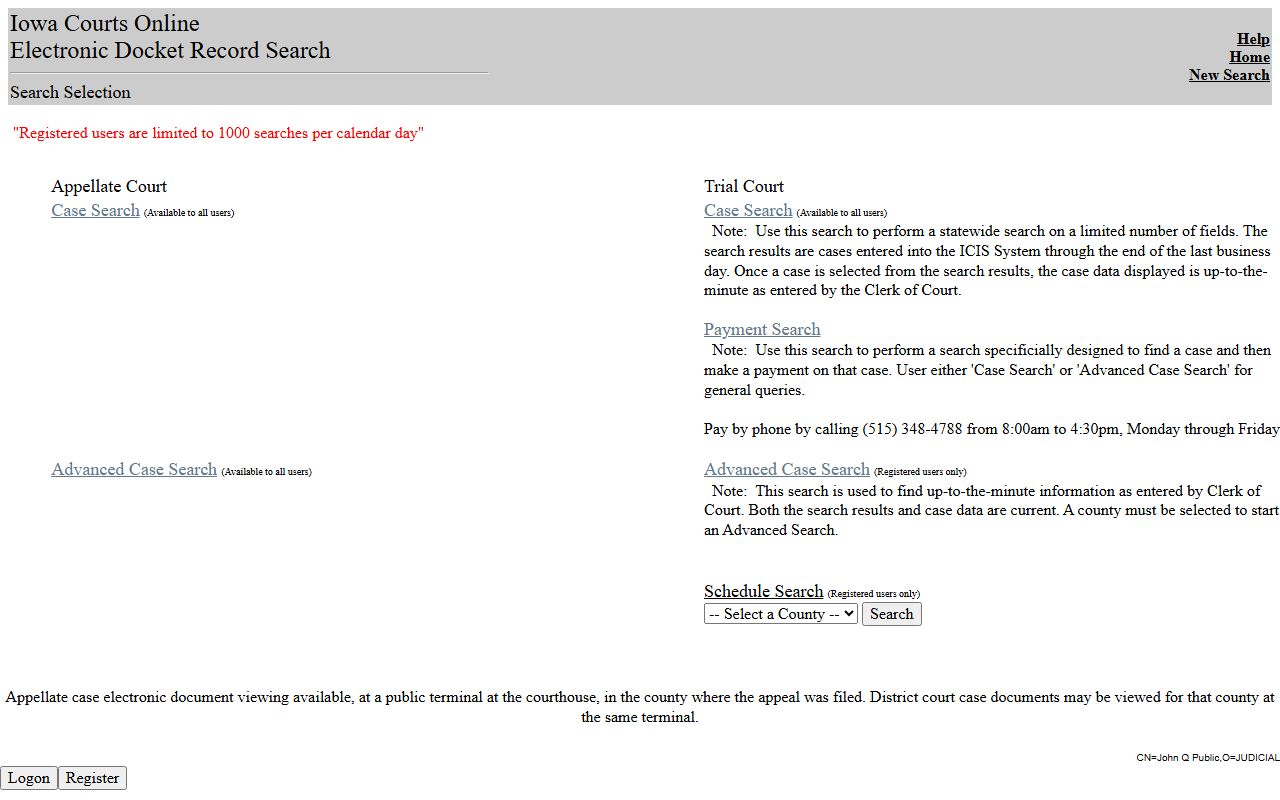
That statewide search page matters because Mills County criminal charges are filed in Iowa's court system, not in a sheriff-run public case portal.
Mills County Court Search Fields
The court-search field inventory is based on the Iowa Courts Online guide and official search page language. The public-facing court system is not the same as a jail roster. It is built around cases, parties, and payments. A booking may happen before the docket appears, so a same-day arrest may require both the jail phone and later court search.
| Field or Mode | Type | Required | Notes |
|---|---|---|---|
| Case Search | Search mode | No | General trial-court query path. |
| Advanced Case Search | Search mode | No | General query path with more filters. |
| Payment Search | Search mode | No | Used for fines and court-debt payment searching. |
| Case number | Text | Optional but useful | Best when a citation, complaint, or docket number is known. |
| Party name | Text | Optional but useful | Public docket information can include party names. |
| Attorney name | Text | Optional | Useful when the lawyer is known. |
| County | Filter | Optional | Use Mills County for local cases. |
Mills County Arrest Charging Documents
Court records after a jail arrest often start with a charging document. Iowa Code chapter 804 says a criminal proceeding may begin with a complaint before a magistrate and that a warrant may issue if probable cause appears. A prosecutor may later file or amend charges as the case moves. The exact document type depends on the charge level and the court process, so the docket must be checked instead of relying only on the booking charge.
| Document | Plain-English Role | Why It Matters |
|---|---|---|
| Complaint | A sworn statement or filing that starts or supports a criminal proceeding. | Often connects the arrest facts to the first court case record. |
| Information | A prosecutor-filed charging document. | Can show the charges the County Attorney elects to pursue. |
| Indictment | A grand-jury charging document. | Less common, but it can control serious criminal filings when used. |
The Mills County Attorney staff directory lists County Attorney DeShawne Bird-Sell and the office at 418 Sharp Street, Glenwood, IA 51534. The office phone is 712-527-5233, fax is 712-527-9767, and hours are Monday-Friday, 8 a.m. to 4:30 p.m. Unrepresented defendants who want to contact the office about a case must obtain written court approval before contacting the County Attorney's Office.
Mills County Charge Status
A charge is not the same thing as a conviction. It is an accusation filed in a court case. Charges can be pending, amended, reduced, dismissed, or resolved by plea or trial. The jail may have an early booking charge, but Iowa Courts Online is the better source for how the filed charge stands after the prosecutor and court act.
| Status | What It Means | Where to Check |
|---|---|---|
| Pending | The charge is active and not yet resolved by dismissal, plea, verdict, or other final action. | Iowa Courts Online and clerk records. |
| Amended or reduced | The filed charge changed from the original accusation or was lowered to a different offense. | Docket entries and filed documents. |
| Dismissed | The court record shows the charge was dismissed, but related booking or arrest records may still exist. | Disposition entries and orders. |
| Convicted | A guilty plea or verdict resulted in conviction and sentence terms. | Disposition and sentencing entries. |
| Warrant active | A warrant may remain tied to the case, failure to appear, or other court order. | Iowa Courts Online and sheriff confirmation. |
Bond After Mills County Arrest
Mills County does not publish a detailed local bail FAQ. The official channels are the jail line, Iowa Courts Online, the Clerk of Court, and Iowa Code chapters 804 and 811. The jail may be able to confirm whether a person is currently in custody and whether bond information can be disclosed. Iowa Courts Online can show court orders and docket events once the case is filed. The clerk is the custodian for court records and certified court documents, not the sheriff.
| Need | Official Channel |
|---|---|
| Current bond amount or whether the person can bond out | Mills County Jail, 712-527-4275. |
| Court case, bond order, or release condition | Iowa Courts Online trial-court case search. |
| Certified court record or clerk question | Mills County Clerk of Court, 418 Sharp Street, Glenwood, IA 51534, 712-527-4880. |
| Prosecution office question | Mills County Attorney, 418 Sharp Street, 712-527-5233, subject to contact limits. |
Iowa Code chapter 811 says defendants are generally bailable before and after conviction by sufficient surety or subject to release conditions or own recognizance, with statutory restrictions. Own recognizance means release based on a promise to appear without posting cash, when the court allows it.
Mills County Warrants and Arrest
No official Mills County active-warrant search page was located on the county site or sheriff page. For warrant confirmation, use the Mills County Sheriff's Office or jail and avoid relying on third-party warrant pages. Iowa Courts Online can show related pending cases, docket entries, and case status. For federal warrant or fugitive context, use the U.S. Marshals Service Southern District of Iowa contacts.
Iowa Code chapter 804 covers the warrant and arrest framework. Section 804.1 allows a criminal proceeding to begin by complaint, and a magistrate may issue an arrest warrant if probable cause appears. Section 804.14 addresses notice of arrest. Section 804.21 covers appearance before a magistrate after arrest on a warrant and includes release and bond-schedule procedures.
Mills County Charges vs Convictions
Court records after an arrest should be read by stage. A charge says the government accused a person of an offense. A conviction means the case reached a guilty plea, guilty verdict, or other conviction entry. A dismissed charge is still different from a conviction, and a booking record is different from both. Public docket information may show all of these stages, so the disposition line matters.
| Issue | Charge | Conviction |
|---|---|---|
| Stage | Accusation filed in a case. | Resolved finding of guilt by plea or verdict. |
| Proof level | Based on probable cause or filed accusation. | Based on plea or proof beyond a reasonable doubt. |
| Record location | Docket charge list and filings. | Disposition and sentencing entries. |
| Custody effect | May affect bond and pretrial custody. | May lead to jail sentence, probation, fine, or DOC transfer. |
Restricted Arrest Court Records
Iowa Code chapter 22 is the main public-records law for county records, but access is not absolute. Section 22.7 lists confidential-record exceptions that can affect law-enforcement material, protected personal data, juvenile matters, and other restricted records. Court records may also be limited by court rules, sealing orders, expungement eligibility, juvenile confidentiality, or protected-party restrictions.
| Term | Plain Meaning | Effect on Search |
|---|---|---|
| Sealed | Hidden from ordinary public view by rule or court order. | Public search may not show the full record or may show limited information. |
| Expunged | Removed or treated under a statutory clearing process when eligible. | The public court or agency record may be restricted after the order. |
| Redacted | Public copy is released with protected information removed. | A record may be available, but names, identifiers, or facts may be withheld. |
Key access law: Iowa Code chapter 22 gives broad public-record access, but confidential exceptions, court orders, and juvenile rules can limit release.
After Mills County Sentencing
After conviction and sentencing, the record path can shift. The sheriff history page explains that simple and serious misdemeanor sentences may be served in the county jail, while aggravated misdemeanor and felony convictions may lead to state prison. Once a person moves to DOC custody, use the Iowa DOC Offender Search rather than a Mills County jail inquiry. DOC states offender records are public under Iowa Code section 904.601(1), updates the search weekly, and warns that information may not always be the latest or most complete.
Federal cases follow a different path. BOP covers federal inmates incarcerated from 1982 to present, while federal pretrial custody may involve the U.S. Marshals Service. Immigration detention is separate again and should be searched through ICE ODLS. These systems do not replace Mills County court records, but they help locate a person after custody leaves the local jail or state-court setting.